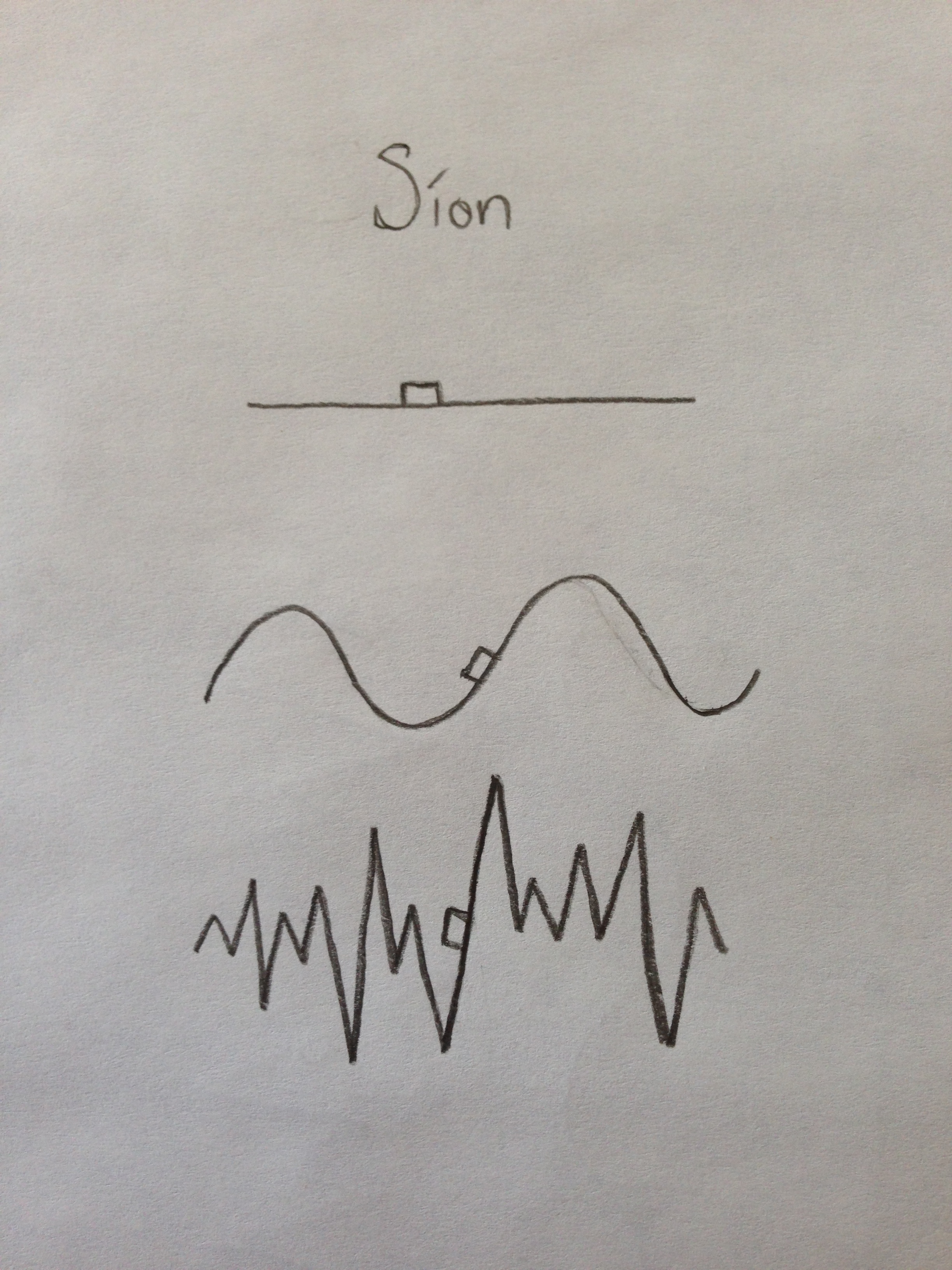

i keep losing heart

The summer between 10th and 11th grade was a time of training — after playing junior varsity soccer for the first two years of high school, it was time to try out for the big leagues.   The varsity coach came from a track background though, so part of tryouts was a mandatory run.  We had to do the 800m (twice around a standard track) in something like 2:20.  If you couldn’t do it, you couldn’t make the team, simple as that.

So I spent the summer going periodically for runs.  I would lace up my shoes, run down the road for a while, then run home.  I did this kind of a lot, I don’t know, I mean it felt like a lot.  I absolutely hate running.  When we had to run on the JV team, these long cross-country 5k type runs, I would hide behind a car with my friend the goalie after the first turn took us out of eyesight.  Then we’d just catch up as the group came thumping back around.  The coach, Gilbert, was something of a space cadet.

Running for me, in all the sports I played, was never connected in any meaningful way to being successful in games, scoring more goals, whatever.  I’ll compete until I collapse, but when I run it’s just me and this little voice on a loop in my head: “this hurts, I can’t breathe, this hurts, I want to stop, let’s stop.”  It was something I was forced to do, all the god damn time, for soccer, hockey, baseball, lacrosse, every god damn thing, and mostly by men who were overweight balding alcoholics, men who enjoyed yelling like drill sergeants, men whose own glory days had ended with their proms.  Maybe that’s not fair.  The point is I hated it.  I still hate it.

That summer wound down, and eventually it became the week before tryouts.  An old friend of mine, a year older, happened to be at the track one day when I showed up to run.  He’d made the leap to the varsity squad last year and knew the deal, so he offered to time me.  As I came around the home stretch, he held up the stop-watch and started yelling out encouragement, and I found myself running like I’d never run before, rounding the final corner, gulping breaths like a drowning man.  When I crossed the finish line I crashed down and collapsed, helpless, on the red rubberized track.  From my wheezing vantage point on my back, unable to speak, the look in his eyes was worrying.  When I caught my breath and managed to ask, he told me, tactfully, that I wasn’t even close.

A week later, at tryouts, I tried.  Really I did, but what I had learned that day was that this run required basically sprinting the entire 800 meters.  To my genuine surprise, the jogging I’d been doing all summer had been woefully inadequate.  Given my apparently lackluster training routine, I simply wasn’t physically capable of it — without a time machine, it wasn’t going to happen.  So I  tried, and I failed, and I packed up my things, and I went home.  For the last two years of school I played tennis.  The tennis coach didn’t give a shit about running.

I say this a lot, and I’m sure my friends and family think I’m being sort of a dickhead every time, but I really believe it: there is metaphor in everything.  It’s the great gift I’ve taken from writing, a wisdom that extends beyond poetry, the idea that there is connection and meaning and symbolism everywhere, not just in art, but in life.  Awareness cuts both ways though, and metaphor doesn’t discriminate between happy or sad, good or bad; these are human concepts.  Metaphors are just connections, lines between two points. And this one really haunts me.

I think I’m trying.  I really do, and I find this life incredibly difficult, every day is a struggle inside myself.  And yet for all that striving, there’s precious little to show.  I’m 31 years old, living in an un-insulated room, with no career, a handful of crumpled dollar bills, and a pile of little arts that I find beautiful but nobody sees.  When I reflect on that honestly, there is a part of my brain, a part that I hate, that wonders:

am I just… jogging?  

Listen, Please Listen — It’s In There With You

Oh little one, locked away
with such lovely distractions,
in the bone box you built
by yourself. You’re not safe
in there anymore, can’t you
understand that? You can’t
hide from the world inside
your own head, it doesn’t work
like that. There’s still time, love,
and light, love — Come outside
yourself, please.  It’s not safe.

“The devil said, ‘I’m a dream, and you’re alone…'”

no bold villain

“The world runs on the fuel of this endless, fathomless misery.  People know it, but they don’t mind what they don’t see.  Make them look and they mind, but you’re the one they hate, because you’re the one who made them look.”

-Karen Joy Fowler, We Are All Completely Beside Ourselves


sam stone

Here’s a leap for you: modern ideologies are just window dressing; we’re all ruled by the same supra-national murderous fucks. As end-game global capitalism approaches, the merchant-kings atop the great monopolies will openly ascend to their thrones, the morality of profit will at last supplant and destroy what’s left of our aggregate decency, and we as a species will become nothing but an empty host for the carnivorous mask of market “freedom” we once put on to use — one that fit so well we couldn’t pry it off, even as it ate down to the bone.  This soulless incorporated nightmare with its fixed leather face will then burn through the galaxy or annihilate itself, either, with equal indifference.

Still with me?  I mean, it doesn’t have to be like that.  There’s still time, something drastic could be done.  If I were a betting man, though, I’d say…

“Jesus Christ died for nothing, I suppose…”

changes

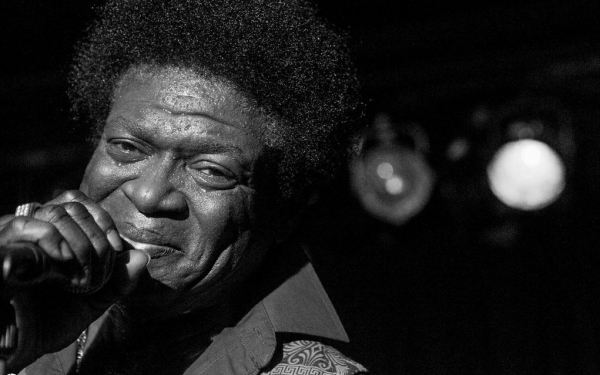
Charles Bradley listens to Charles Bradley sing Black Sabbath. I’ve been covering this over and over on the guitar for the past 48 hours, and each time I have to stop and interact with the world it’s still there, coloring everything, the last notes ringing echoes in my saturated brain.  If a little cry helps get it out, that’s okay.  I would if I could.  It’s been a powerfully atmospheric couple of days, weeks, years…

“I lost the best friend I ever had…”

beat (health, life, and fire)

Bright and warm and fun, Thao Nguyen & The Get Down Stay Down are my gift to you on the eve of real spring.  You can’t see it, but I’m clapping my hands here like an excited little girl.

Spring!

It’s coming!

Spring!

“I must battle without her…”

big mistake

The two ends of the bell curve, the perfect human and the worst of us, can have each other.  I’m not interested in either of them, except insofar as if the perfect human were ever born, perhaps it would do something about the worst of us.  The evil ones who rule the earth can go fuck themselves, I’m doing my best to opt out of their world entirely, and the perfect human?  Well, it would be an interesting phenomenon, but the philosopher king wouldn’t be one of us at all.

A perfect human is no human, our tragedy is our beauty is our definition.  What makes life worth living for me is to be among the ones who scuffle in the dark, always stubbing our toes, crashing to the floor, destroying what we struggle to build.  I’m here for the ones who are doomed and flawed and know it and try anyways.  A perfect person does nothing for me.  I’m in love with the cracked ones who care.

purple rain

Ah, geez.  Well there are a million obituaries popping up all over the internet, and it would be a waste of time for me to throw my hat into that ring.  So I’ll talk instead about the time Prince came to visit me in hell.  Let’s back up for a minute and start this story at the beginning: with karaoke as an institution in Taiwan.  It’s a big god damn deal.   There are these massive skyscrapers that dominate the commercial districts of Taipei, each one basically a luxury hotel, all of them devoted exclusively to karaoke.  It’s a really big god damn deal.

The American model of getting drunk and embarrassing yourself on stage in a public place, a model where you expect and basically invite ridicule, has no place here.  This is much smaller, and much more serious.  You rent these hotel-room-sized spaces, replete with couches and menus, then order up food and drink.  It’s intimate, and straight-faced, and there’s no giggling at singers allowed.  I had a friend who would sometimes rent a room and do karaoke by herself when she felt sad — that was actually the sanest thing about her (the final straw was her mailing, physically mailing, an envelope to my parents in the US with pictures and a note she had written pretending to be me… but, I digress).

So anyways, you’re in this room, and the music is terrible.  I cannot stress this enough.  Except for an exceedingly tiny, exceedingly awesome bohemian subculture, the sound-track to modern Taiwan is big-hair-blowing pop stars beating their chests and professing their homogeneously generic love/lost love.  It’s just, gag.  I know, commercial music is bad everywhere, and cultural relativity, etc… but I’m sorry, straw man who is judging my judging, you didn’t have to sit through it.  I did.  So I would sequester myself in the elbow of the L-shaped couches with a bucket of beer and a bottle of whiskey, and get absolutely smashed in an attempt to blunt the assault of super-serious banality, at which I wasn’t even allowed to poke fun.  It was relentlessly awful.

But before all of that, before getting wasted and before the night devolved into whatever blurry mistake those sweaty rooms became for a blackout drunk, I made sure to grab the booklet and leaf through to the small section of English songs.  Most of these, of course, were abysmal boy-band shit as well, but, without fail and for whatever reason, they always had Purple Rain.  And so it went to the back of the queue, behind all the Chinese pop songs, sorted and forgotten.

At that point in my life, I was only going out to escape the hellscape inside my head.  I was there because I couldn’t stand the destructive, spiraling, heartbroken darkness I was living in alone anymore, and so I sat, and tried not to visibly hate everything, and drank.  Hours later, as the room was starting to dim and smear, the sound of that purple guitar rolled from the speakers like a revelation.  Mid-conversation I lurched across the couch, over an irrelevant number of unfortunate people, and grabbed the microphone.

For a kid drowning in the quicksand of written-by-committee, soul-less, art-less, commercial garbage, drowning himself in darkness and demons and dead dreams, Prince appeared as a pair of purple wings.  This raw virtuoso, who played every instrument, who sang with such an infectious passion you couldn’t help but feel, man, when that guitar came on… Well, like I said, I was very drunk — It got emotional.  Whatever else happens, whatever you’ve had to endure, there are no truly terrible nights in which you’ve sung the entirety of Purple Rain.  That’s just fact.

So rest easy, sweet The Artist Formerly Known As The Artist Formerly Known As Prince.  Rest easy you gender-bending, multi-instrumental, sex-symbol, rock-god prodigy.  I’ll always remember you as the sultry purple angel in my hell.

“I never meant to cause you any sorrow…”

[ed: they keep deleting the video — find it here if the embed is gone.]

the good times are killing me

When you really get down to it, most musicians are lazy writers.  Music can get by on the strength of a funky baseline, and falls prey very easily to the positive feedback sickness of “good enough.”  That’s fine for a certain sub-set of listener (i.e. the top-40-consuming public) but I demand more, because I know if you push there is more.  As someone who has spent a lot of time writing, most lyrics read to me like shitty first drafts.  There’s potential in there, but if you were at a bar and someone wrote the words to any Red Hot Chili Peppers song on a napkin, handed it to you and said it was a poem they wrote, you would struggle not to laugh at them.  It’s a bunch of stream of consciousness, “good enough,” first draft, you-figure-it-out garbage.

When you take a step back, this isn’t that surprising — writing and music are two separate mountains, each requiring a lifetime of struggle to climb.  But the only songs for me are the ones that go beyond the good into great, and lyrics are always the final push that gets them there.  Composing melodies and writing poetry are two very different, very difficult things; Isaac Brock puts the lie to the idea that you can’t do both.  He’s a musician and a writer, and sings lead with a crazy lisp.  He is awesome.  Here’s a guy, I guarantee, who writes a second draft.

“Jaws clenched tight we talked all night oh but what the hell did we say?”

i am sailing

Ph’nglui mglw’nafh Cthulhu R’lyeh wgah’nagl fhtagn…

“In his house at R’lyeh, dead Cthulu lies dreaming…”

love and mercy

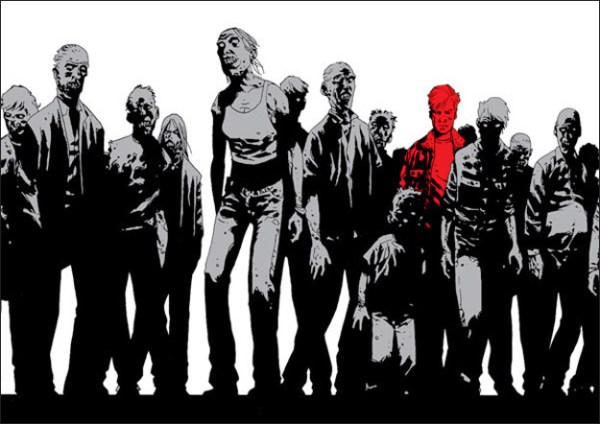
Speaking of Brian Wilson, the folks behind the television adaptation of The Walking Dead commissioned a cover of his song, “Love and Mercy,” specially for an episode of the show.  This is the same brain-trust that opened recently on a tribute to David Lynch’s ear-in-the-grass scene from Blue Velvet, an homage so obvious it had me giggling incredulously in my seat.  I began the series with Robert Kirkman’s jaw-dropping graphic novels, and they were so damn good (seriously, so damn good), that I didn’t really want to watch a television adaptation — I figured it would just be cheap/effective tension tricks and cliffhangers to sell advertising.  It’s a rare thing, and don’t tell anyone I told you this, but every once in a while, I am in fact, wrong.

The acting, the writing, the loving but not slavish handling of the source material, all of it is top, top notch.  More than anything, they understood the thesis of the series, which is the thesis of all zombie movies stretching back to George Romero’s Night of the Living Dead: nothing actually changes in the wake of a zombie apocalypse, it’s just that death has now been given form.  For us pampered, bovine Americans, droning the days away in whatever combination of work and escapist fantasy we prefer, the specter of our own mortality is this impossible thing.  We lock that awful knowledge in a room, refuse to acknowledge we’ve done so, then pretend it doesn’t exist.  Is it any wonder then, that when it bursts out, as it must, we are woefully unprepared to face it?

Death in a zombie apocalypse is just another part of life, the same way it was for our ancestors, the same way it is for people in less developed parts of the world.  It’s always there, and every day could be the day we slip and it snatches us down.  Done correctly, zombies are nothing more than shambling, grotesque, excellently articulated metaphors.  They’re the doom that stumbles along next to us, clutching vainly at our ankles; the clumsy, absurd half-wit, that despite all our best efforts, will someday eat us alive.  It’s always there, always waiting, but better that it’s part of the scenery, moaning softly where we can see it, than forgotten in the closet, pawing at an unlocked door.  Death comes for us all in the end, sure as shit, but it’s not necromancy and it’s not evil, it’s just a part of life — and life, my friend, is beautiful.

“So love and mercy to you and your friends tonight…”

a day in the life of a tree

For a brief moment, Brian Wilson and the Beach Boys were truly the American equivalent of the Beatles.  Pet Sounds was an acknowledged influence on the famous Liverpudlians, and the sad pun of Surf’s Up, so darkly powerful in its simplicity, stands in stark contrast to the beautifully arranged, sun-soaked nothing on which they first ascended.  “Surfin’ USA” was their “I Wanna Hold Your Hand,” and vapid commercial success became for them as well a spring-board to serious art.

When I say them, though, what I really mean is Brian Wilson.  This is important, because that primary difference, the lack of diffusion in talent, became a problem when he gained a hundred pounds and fell apart inside himself.  Imagine if the Beatles were really only John, and then John lost his mind; that’s what happened.  Brian Wilson was perhaps the finest singer/song-writer of his generation, John and Paul included, but though he was a towering talent, and a beautiful artist, he was also very, very sad.

“Trees like me weren’t meant to live…”

the undertow

Joshua Clark Orkin

it’s always there the signs were clear
there’s no lifeguard on duty here
my mother said you mustn’t fear
the ocean but respect it, dear
for if you swim you have to know
that some go down with the undertow

the fields are waiting gold and fair
they’d cradle my head and play with my hair
but i have got the longing stare
and what i seek is way out there
you’ll never reap if you don’t sow
though some go down with the undertow

i know it’s all some bright disease
the crazy lust for shining seas
i’ll miss your laughter in the trees
but i won’t miss begging from my knees
the skies will rend and a wind will blow
when i go down with the undertow

so if one day it comes for me
just let me go i’ll be fine you’ll see
the end at last will set me free
and peace compose me gracefully
the stars will shine and a wind will blow
when i go down with the undertow.

johnny and mary (feat. bryan ferry)

In this slow cover of an up-tempo ’80s song (a bit like “Mad World,” of Donnie Darko fame) Todd Terje takes over where Bryan Palmer thought he had finished.  Covering an ’80s song with ’80s prom-music synths just tickles me all over, and digging Bryan Ferry up out of his ignominious retirement to sing it was a stroke of genius.  The original’s lyrical excellence, the loss and regret in Ferry’s voice, the booming bass and retro synths — this song gets a lot of things exactly right.  Your mileage may vary, but I find the whole thing strikes way too close to the heart.  I find it really emotional.

“Johnny’s always running around
trying to find certainty

he needs all the world to confirm
that he ain’t lonely…

Mary counts the walls
knows he tires easily…”

this modern love

Another old Concert à Emporter from the early days.  Vincent Moon, my hero of musical film-paintings, is the fellow smoking and imploring him to sing.  Kele, the man being implored, is both famously shy and gay.  I like this a thousand times more than the polished studio version.  A thousand thousand times more.

“Shh…

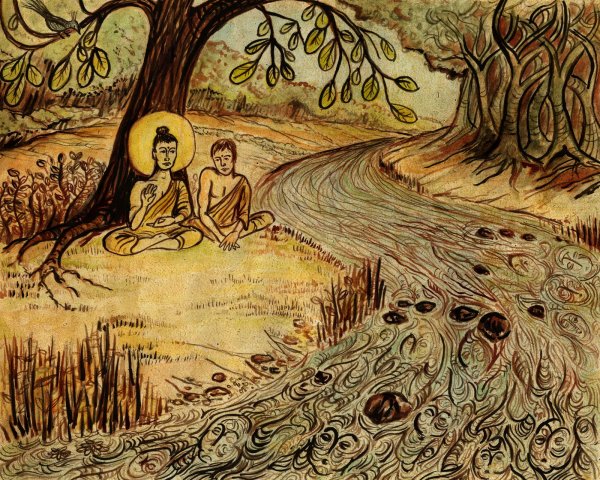
kasyapa and the flower sermon

“Alright, I’ll tell you one.  Just one, then you’ve gotta go to sleep.  Your mom’s already going to kill me for letting you stay up this late.  Deal?”

“Deal.”

“I’ll tell it to you as it was told to me, but forgive me if the details aren’t perfect, this old brain has seen better days.  You remember Siddhartha?  From last time?”

“Yeah, the prince who gave up all his money.”

“Yeah, that guy.  Well, he had been on the road a long time now, and a group of people had taken to following him.  Each morning at dawn these folks who had abandoned their lives gathered to hear Siddhartha talk.  The talks weren’t religious, not in any organized sense, he was just thinking out loud, trying to figure out how to live.  One of these followers was a young man named Kasyapa.  He was new to all of this, Kasyapa.  He struggled with the teachings, and the others made fun of him for his difficulties.  But still each morning he came and sat before Siddhartha and tried to understand.

One morning the people gathered as usual, but instead of speaking, Siddhartha held up a white flower and sat looking at it. His students waited patiently for him to begin.  Minutes passed.  Then hours.  “What is it?” Someone asked. “What’s the lesson?” said another. Soon it was noon, and still Siddhartha simply sat in silence with the flower.  One by one the people, shaking their heads, some in confusion, some in disgust, rose and went about their daily chores.  There was still much to be done in a camp in those days, even for poor wanderers.  So they drifted away, until only Kasyapa was left, sitting alone before the portly sage.

He stared and he stared, this boy, with his brow scrunched and his tongue peeking from the corner of his mouth.  He tried with all his power, straining until sweat beaded on his brow, but nothing changed, nothing became clear.  “I’m sorry, master, I don’t know what you want me to say. I don’t understand.”  Siddhartha just sat, unchanged, looking at the flower.  Kasyapa let go a long breath, closed his eyes, and bowed his head.  He had chores to do.

Before he got to his feet, however, he looked one last time at the flower.  And this time, in a wordless stillness that stretched on forever, he looked and he saw.  And he smiled.  When he looked up, grinning, at Siddhartha, the Buddha was smiling back at him.”

“…”

“…I don’t get it.”

“Hush now, give it time.”

“But, why–”

“Shh, child.  Stop talking.”

“But–”

“Stop talking and you’ll see.”

Website Powered by WordPress.com.

Up ↑