What we think of as normal in this era of regimented specialization is the one-in-a-dozen take, where everything goes just right. We so rarely see the real people behind the perfect curtain, being flawed and fucking up. But because of the holy shit moment at the end, getting the music just right suddenly became secondary. They had no choice — this was the take. The whole thing is a mess: the guitarist and saxophonist both miss notes, the drums are regularly off-beat, and to top it off, the players privately hate each other. Shortly afterwards, the lead singer would quit the band.
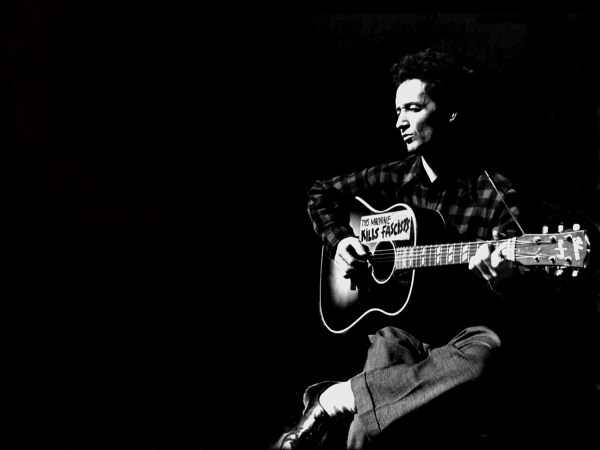
Woody Guthrie, on his deathbed, continued writing song lyrics. Too sick to perform them, or even set them to music, they all ended up in the care of his wife after his death. Years later, she contacted Billy Bragg and Wilco and tasked them with making his words into songs. Mermaid Avenue is the result of that tripartite collaboration. This song in particular always spoke to me.
I’ve been holding off on this for a long time. Almost a year now, since I first started this thing (has it really been a year? Christ). I held off because this could easily have devolved into simply reposting la blogotheque’s content and making the bindle a Vincent Moon fanpage. The fact that this was a concern says a lot about how much I loved what he was doing. For a long time, these Concert à Emporter were my special secret thing, this little perfect place on the internet where I would bring my favorite people when I wanted to un-cup my hands and show them the light I was holding.
The early videos were ingeniously simple in their concept: Vincent Moon got artists to Paris, put a mic on them, then followed them out into the world. Most of the early bands didn’t know it, but this wasn’t just about the music, it was an artistic collaboration. Vincent is not simply a producer, he’s an artist himself; the best of these were little films, and they were exactly what a music video should be. The casual intimacy and art-school sensibilities of his approach were so obviously successful that they’ve now been appropriated and imitated ad nauseum. Yeasayer went on to warp their sound and sputter out, and la blogotheque outsourced, grew unwieldy, and mostly lost their touch. It no longer seems novel, because it isn’t.
But there was a moment, early on, when they were just catching lightning in a bottle, one bolt after another. It was unbelievable how good the work was. After growing up on ’90s music videos, lumbering abortions that cost hundreds of thousands of dollars and were shining plastic piles of self-congratulatory shit, these first few Concert à Emporter just knocked the air right out of me. I was stoned and un-prepared, and they left me grinning like an idiot child with an ice-cream cone on a hot summer day. It became my secret, special thing, the light I kept cupped in my hands. So here’s my very favorite one, the best bit of bottled lightning. Open it, and wait for the thunder.
I came to Radiohead late, and in the end I’m grateful for that. It makes me think back to the closing scene of Fight Club, as the story builds to its climax and the buildings are collapsing, when we get the first strains of The Pixies’ Where Is My Mind? I’ve often wondered who had that moment better, those who knew and recognized the song and went, oh yes, fuck yes! or those of us who had never heard that shit before and felt it for the first time as buildings buckled and crashed. I’ll never really know, but in my gut I think the more novel things are, the fresher, the better. So when I finally acquired Kid A, a decade after its release, it had my undivided attention. I got it fresh and pure as forest snow.
I saved the album for the flight home, because I knew it was going to be a tough one. The last time I had taken that 14 hour flight, I’d had an envelope from her that said on the outside, “to be opened on the plane with your hands,” and contained a love letter and a hand-made crossword puzzle. This time, I had only her voice running over and over in my mind, shaking with emotion and the crackle of the long distance line: “I slept with someone… I slept with someone… I slept with someone…” The plane took off and I dropped into a bottomless sleep.
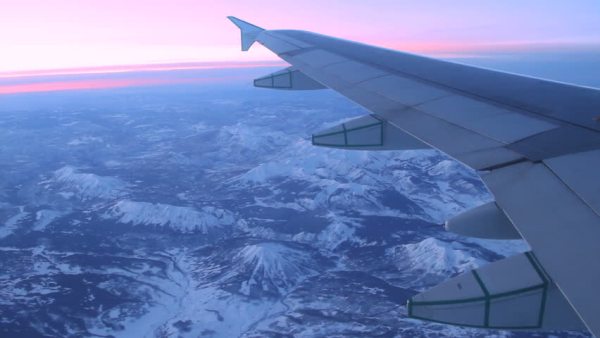
When I woke up all the windows were down and the cabin was dark. I took out my old iPod, put on headphones, and hit play on Kid A. As the first song began, I cracked the window and found myself at 30,000 feet while dawn broke over the ice at the top of the world.
I was a mess, and would continue to be a worsening mess for a long time yet to come. Even back then, at the very beginning, some part of me knew that. But everything out that window was blue and white and clean and fresh, way up there in uninhabited nowhere. As the first notes of Everything In Its Right Place played, and pink and orange washed and mingled with the blue and white and purple of that pristine wasteland, something broken inside me collapsed and fell and landed where it belonged. The colors, the music, the timing, the contents of my head — it was perfect, all of it, and no less so for being sad.
Then a flight attendant tapped me on the shoulder. When I turned and lifted the headphones she scolded me for introducing light into a cabin where everyone was sleeping. Scowling, I shut the window, the moment passed, and everything was awful again.
But there is meaning and metaphor in everything, even that, and this time I closed my eyes, exhaled, and savored it — all the beauty and the pain, all the banality and love and absurdity, everything, all of it. I sat there helpless, heartbroken, in that uncomfortable seat in that claustrophobic cabin, and an idiot smile bloomed across my face.
Life, even and especially at its lowest points, is annoyingly, impossibly, beautiful. The answer to my problems then was the same as it is now: Stop fighting, relax, and let yourself be carried through the clouds.
it’s just hanging there, all the time, every day–
stop–
it takes up half the sky–
you can’t be serious–
and we spend our entire lives–
please? please stop?
i just want to see it, you know? the whole thing, just once–
then it’s the last thing you’ll ever see–
i know, okay?
Nick Drake put out three albums, was unwilling/unable to promote himself or perform live, and had little to no commercial success or recognition. He ended up retreating from the world, moved back home to live with his parents, and was later found dead with a stomach full of anti-depressants. Today his music is famous.
Do you still want to be an artist?
“and none of you stand so tall pink moon gonna get you all…”
Twice, TWICE, she found a piece of scrap paper on which I’d scrawled the lyrics for “No Children,” and thought it was a poem I’d written about her. The first time I was there and could explain that it was a Mountain Goats song, and that I was trying to figure out how to sing it. The second time we were broken up, and I guess she’d forgotten the first time. I tried again to tell her it wasn’t my work, but it didn’t matter — at that point, I was learning, nothing about us mattered.
The song is dark, and sad, and honest, and beautiful. There’s something perfect about it being sung all together like this, all those people, all those relationships, all that love and lost love. It succeeds where so much art fails: that sweet, sweet, cathartic release.
and I did end up singing and recording it, much later, in St. Louis. It went on the early bindle, which nobody knew about, where nobody heard it, and that was all. Now with a little readership, maybe it’s time to bring it back. If this is a repeat for you, my friends, forgive me. And if you and I lived the reality of this together, please, also, forgive me.
Credit Dr. J. Oseph for the tip on the blackout Mountain Goats version. Further proof that scientists and artists are natural allies.
For most of my childhood, the three main activities were reading, sports, and video games. In the eyes of my parents, one of those things was awesome, one was healthy, and one was an embarrassing waste of time. What could I say? I liked what I liked, and what I really, really liked were the cutting-edge-for-their-time, 8-bit translated Japanese RPG’s.
I picked up Shining Force randomly at the local rental spot (Before Blockbuster, just somebody’s personal VHS rental business, remember those?) when I was maybe 8 or 10 years old. It was a revelation. I kept renting and returning and renting and returning this game, praying each time that my save file would still be on the Sega Genesis cartridge. Even as an adult, in terms of story and world-building and character development, in terms of sheer inventiveness, I’ve seen it surpassed only once, and that was by its incredible sequel. These games were big, and dark, and complex, with every bit as much depth as a grand fantasy novel, and what’s more, they were interactive. The memory of those characters, that experience, is emotionally resonant to a degree it’s hard to explain. They were important to me.
Every art form has something it can do that others can’t, and for video games it’s the personal involvement you feel when a story runs directly through you. It engages the imagination a thousand times more than passively watching television. And sure, times have changed, and continue to change, as new generations grow up with interactive storytelling as a matter of course. It’s becoming normal. These few paragraphs already are sort of a throwback to a time that children today won’t understand. But we lived through the beginning, and it was weird, and nerdy, and the generation that raised us had been raised on baseball, and bicycles, and neighborhood-wide games of hide-and-seek. They had no idea how to classify this phenomenon except maybe as, “dungeons and dragons shit.”
To this day I still carry a sort of embarrassment for playing video games, a reflexive sense of, “you’re wasting your life inside, playing on that thing,” that was shamed into us early and often; and sure, everything of course in moderation. But there is also a part of me that knows and always knew the truth: It isn’t that video games are changing; it’s that perception is finally catching up to reality. This is, and always has been, an artistic medium. All those little unlined faces, sitting cross-legged in the glow of the television, unfolding a living adventure to Motoaki Takenouchi’s piano compositions? They knew it was beautiful; it didn’t matter that nobody else understood. There’s a moral in here, somewhere, about giving a fuck what other people think.
They were laughing, those two gnarled women, and I was livid. When we left that morning before sunrise to climb to our mountain-top listening spots and wait for the gibbons to call, we had expected them to get up early and come be here at camp, as discussed and agreed, to watch our shit. They were the wives of our two field assistants, they lived in the nearest village, and they were getting paid to do this. Instead, when we finally stumbled back into camp that afternoon, tired, dirty, and defeated, they had just gotten there. And they were pointing at my tent, and they were laughing.
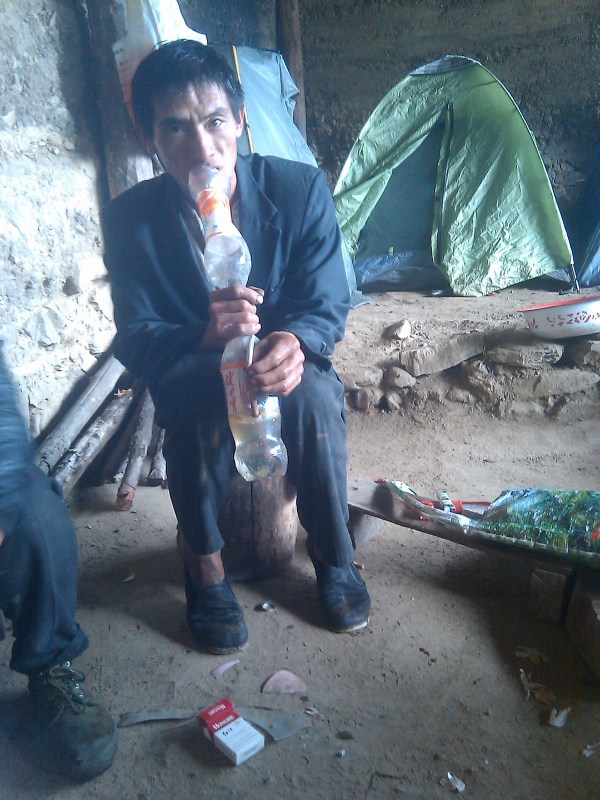
I listened to this song every night during those months in southwest China. In those empty mountains, those empty forests, where all the major wildlife had been hunted to extinction during the Great Leap Forward, we were alone at times on a geographic scale you only find in a country the size of China. It was intense, and sometimes lonely and terrifying, and each night as I got snug in my tent, on my thermarest, inside my sleeping bag, I put this on and let Grandaddy welcome me back into the world I loved, back into art and beauty and music and imagination. Instead of an escape from reality, from the struggle and the beauty of this place, it was instead a layering of two disparate lives: the textures of where I had come from and where I was, combining in my tent and in my ears late at night, sending me off to sleep content.
It was goats. The women were laughing and pointing at my tent because goats. Our field assistants, whose wives these women were, were difficult in their own way, and had housed us in an ancient abandoned goat-herder’s hut rather than finding an actual site to camp. So these godless animals wandered unimpeded into their familiar shelter that morning, then on into my tent. They stomped on and popped my thermarest, ate up my rolling tobacco and papers, devoured all the various prescription pills (one of them got a percocet, I bet that was a weird night), munched through my headphones, and generally destroyed my sweet little haven where I’d fled the struggle at the end of each night. We patched the thermarest with duct tape, but despite high hopes it never served as much of a mattress after that, leaving me to wake on the cold forest floor each morning on a sad piece of deflated plastic.
I managed to score a janky pair of replacement headphones from someone–it was China, after all–and even though the sanctity of my haven had been violated and defiled, even though Joe had to hold me back from launching myself at those two cackling witches, I got into my tent that night, put this song on, and exhaled. There in the dark, surrounded by nothing but mountains and trees and the most stunning panoramas I’ve ever seen or hope to see, on the run from a modern human existence I couldn’t handle, alone in a tent in nowhere China, I listened to this song. It saw me through.
“Get a job, you lazy piece of shit,” said one poor man to another.
“I have reservations about this system,” said the second poor man, “and I’m mentally ill.”
“Too bad. If you don’t grow the GDP, you don’t get to see a doctor,” said the first poor man.
“No, that can’t be right,” said the second poor man.
“Yeah,” said the first poor man, “It is. Put your head down and quit asking questions. Grind it out like a man.”
“Who benefits from my doing that?”
“You know,” said the first poor man, “I’m not sure. Probably some rich guy.”
“So why are you yelling at me?”
The first poor man wasn’t sure. He remembered someone on TV…
Running in the Rye:
we focus on the shiny things
your girl she needs a diamond ring
get a job the caged bird sings
if you work hard you can be king
(throw it all away)
go to work and punch the clock
swing your pick and break the rocks
beat your chest and grab your cock
don’t ask why the doors are locked
(throw it all away)
we based our lives on older men
who worked and drank and had us then
spent their days wondering when
life would finally come for them
(throw it all away)
it’s quitting time you’d better go
home you married her you know
pop a beer and watch the snow
you’ve already seen this TV show
(throw it all away)
While a student at NYU in 2001, Daniel Rossen, later of Grizzly Bear fame, started a project with Fred Nicolaus that would become Department of Eagles. Whitey on the Moon, their first LP, is a weird one; very different from the music that fueled his wildly successful career. Assembled with pirated recording software on a borrowed microphone, it’s mostly beats and samples, and in many ways it’s a dreadful mess. At the same time, it’s also this.
We’ll get to Grizzly Bear later. Hell, we’ll get to Department of Eagles circa 2008 later. Both are excellent. For now though let’s begin where they began, before the lights and the studios and the money and the fame:
I always thought IN [Strong Looks] the best of the bands that swirled up like sparks when Animal Collective struck the earth. Unfortunately, they rode the strength of those early EPs to a name change and flash-in-the-pan notoriety as Keepaway, then fizzled from the world. Now I can’t find them anywhere on the googles. Though they no longer exist in our dimension, however, IN [Strong Looks] lives on, here, extant in the pseudo-reality that is the bindle.
A song with the pure ring of truth. It gripped my sadness and squeezed, the first time I heard it and again every time after. The bass line alone is enough to slightly elevate my pulse. But it’s precious to me, that awful feeling, and I savor the richness of it every time.
I used to think about you all the time I would think about you all the time Now it just feels weird; There you are.
Forgive the embed with advertisements, DJ Fresh definitely employs a gaggle of gremlins ready to flag my account if I rip this. Still, it is the rare studio video that’s worth it. That hook. Them ropes. Mm, gold dust.












 handkerchief tied to stick