somebody to love

It took me a long time to realize I had been misled all my life about Success.  In the end, I discovered, you have to do a thing for yourself because it pleases you.  The thing itself has to be enough — all else is smoke and mirrors.  There is merit and wisdom in picking a thing, devoting yourself to it, doing it beautifully, then setting it on fire.  I learned, through much trial and error, that Fame is not Success.

This veneration of individuals, the gurus and cult figures, the phony idol worship, it’s all bullshit — people are just people, even famous people.  Some of them deserve respect and admiration for their craft, sure, but so do all sorts of people.  Fame itself is a vice, and a handicap; a careful-what-you-wish-for.  Venerating fame is a sickness, and our society is terminally ill,  while most of my favorite people toil away excellently in obscurity.

Anyways, you get the point.  I’m not here to meditate on our collective obsession with gossip magazines.  I’m here for Valerie June.

We met once, after a small show she performed at The Dock in Ithaca.  She came out after the lights went up and stood by her merchandise table, where a line formed.  Her hair was enormous and she was remarkably skinny.  People came up to talk to her, and she talked to them.  It was very sweet.  Mostly though, people were talking at her, giving her their opinions on this or that, and I’m standing there thinking, “What are you telling Valerie June?!”  So I got it in my head that instead I would just ask her for a hug, say thank you, then dip.  This became the plan.

So I waited, and waited, and finally the last person left and she looked me right in the eyes.  My mouth went instantly dry, as all my carefully cultivated opinions on fame shattered and rained down around me.  I managed to ask her for a hug and, bless her, she gave me a good one.  Then, having achieved my goal, I started to leave, and — she wanted to talk!  She was asking me something or other, but at this point I was a robot working on its original line of programming:  1. Get hug 2. Say thank you 3. Leave.  She’s being all fucking sweet and human and giving me this strange look as while she’s asking me something, I’m slowly backing away.  I found myself saying “thank you, thank you” over and over again like a broken machine, while half-saluting her.  Yeah, saluting her.  Then I turned and lurched away.

So not my proudest moment.  But I did get a hug from a talented and ethereally gorgeous woman.  And I did get to eat crow and question my convictions, before having them reaffirmed in the best possible way.  I’m sure it didn’t help me any that long before this encounter I had said out loud to friends (mostly joking) that I’d decided to swear off all other women and devote myself exclusively to her.

Don’t tell her that, okay?  This has been embarrassing enough.  But if you happen to run into her, maybe you could, I dunno, test the water a little for me?

I mean people are just people, right?

Even famous people?

“Well if you’re tired, and feeling so lonely…”

https://www.youtube.com/watch?v=40BIOn9mp6c?rel=0

putting the dog to sleep

When I heard The Antlers were putting out a new album, I wondered how they could possibly follow Hospice. If I haven’t ranted hysterically in your presence about Hospice, well, prepare yourself: It’s so good. It’s SO good. The legend goes that the lead singer disappeared into his New York apartment for months, cutting all contact, losing his girlfriend, basically letting the rest of his life atrophy.  Nobody knew where he was, how he was, or what he was doing.  When he emerged one day blinking, back into the light, he was holding the first awkward drafts of Hospice.

What can I say about it?  The back of the book jacket would say it’s a concept album about a hospice worker who falls in love with a terminally ill child(?), with whom he has a sexual relationship and an abortion, and who lashes out in emotionally abusive waves of rage and sadness and frustration as she waits for her senseless death.

Hah.  I know, right?  But it’s also one of the most beautiful things I have ever heard.

Truly incredible.

Anyways, I wondered how they could possibly follow that.  They did it by not following it at all — they didn’t even try to make another Hospice.  Instead they just made a regular excellent album.  Part of what made Hospice so good was that quietly, hidden beneath the avant-guard nature of their accomplishment, The Antlers are excellent pop composers. Combine that with his voice and writing and you don’t need much else.

And that’s the central conceit to Burst Apart; the primary reason for its success: They didn’t try to make another Hospice, because they didn’t have to. They already had all the parts.  The follow-up is dark, but not bleak, and there’s a warmth to the sadness that carries, even in the upper register of his incredible falsetto.

So go get Hospice. I know you won’t, but just, do. Next time it enters the orbit of your life, grab it.  Put on headphones, lie down, close your eyes, and devote an hour to that thing. You won’t regret it. Then when it’s over, come find this song.

After the gorgeous frozen emotional tundra of Hospice, Burst Apart is like getting wrapped in a fluffy blanket and given something hot to drink. It’s still awful outside, and death is still coming — that isn’t going to change — but here at least, you’re watching it through a window.  Here, at least, somebody cares.

“But trust me to take you home…”

https://www.youtube.com/watch?v=TDPdKPOl0Ro?rel=0

promise

“By 1995, Clear Channel owned 43 radio stations and 16 television stations. When the Telecommunications Act of 1996 became law, the act deregulated media ownership, allowing a company to own more stations than previously allowed. Clear Channel went on a subsequent buying spree, purchasing more than 70 other media companies and individual stations.”

Man, this Ben Howard guy.  When I first heard his voice through phone speakers I immediately wanted to dislike him.  Him and his 9 million views.  I know, that’s not fair.  But hear me out.

I grew up in the age of Clear Channel, the media conglomerate that quietly bought up an enormous market share, fired all the independent DJs, and replaced them with pre-recorded patter and standardized set-lists.  These set-lists consisted of whatever media executives paid them the most to play.  Subtly, carefully, without alerting the public that the game had changed, this single corporation neutered and homogenized radio music across vast swaths of the United States, for profit.

Fuck them so much.  Seriously.

Clear Channel and their ilk are the reason an entire generation was subjected to bands like Creed and Nickleback.  Bands nobody asked for and nobody liked, but who had clever and wealthy management, and were bland enough not to rile any focus groups.  Instead of the steady diet of Lou Reed and David Bowie we should have been getting, what we got instead were pre-paid formula songs, selected by empty suits, that then played constantly in the dentist’s office while we read Highlights magazine and waited to get our teeth cleaned.

The local Clear Channel puppet in my time was Lite 97 FM — Cursed be their name.  By the time I hit puberty I had already heard a lifetime’s worth of samey musical mush, all of it polished to a shiny nub of inoffensive nothing and poured down the ears of an undiscriminating audience.  Hell, I was part of that audience.  The radio was where you heard music, that’s just how it was.  That’s how it had been since humans first harnessed the airwaves.  How was I supposed to know the DJs were dead?

My childhood was a dark time for music.  The period between the demise of the DJs, and the rise of the internet was rough, and music didn’t mean much to me as a kid, not really.  I was overwhelmed by the sheer volume of polished plastic trash.  That top 40 shite, for both the suits and the musicians, is all about making money — about “making it — it’s not about making art.  The ongoing commercial success of these people and their barren dreams and hollow ambitions really upsets me.  Can you tell?

It doesn’t upset me so much that they are rewarded — I mean fuck them, I really don’t care if they live in a cardboard box or an island mansion, as long as I never have to interact with them —  it upsets me because in pursuit of personal profit they’re stripping art from the casual lives of people; leaving them to suffer without its solace.  Life is hard enough.  Stop fucking doing that.

So I heard this Ben Howard guy, all polished and professional and what not, and I figured, hell, more studio-executive-approved-focus-group-pandering turd music.  And I shook my fist and got on with my life.  But for some reason I came back to this one.  Despite that initial reaction, I found myself coming back for that melody, that guitar, and I brought headphones this time and, oh.

Whoa.

Then I found myself sitting at my desk, trying to learn it, discovering it’s in this weird tuning — some sort of open D, tuned down a step, then brought back up with a capo.  I couldn’t get it to sound right, so I stopped.  Bah.  But then

I was in the kitchen late at night, cooking a bachelor’s midnight dinner, and found myself listening to it again.  Aw, man, it’s pretty, I thought, but it’s really sad.  And I was standing there all lonely, late at night with headphones on, listening to this guy sing and cooking these really somber scrambled eggs, when the guitar started to pick up.  And then suddenly I was dancing around the kitchen, smiling like an idiot, while my eggs sizzled in silence.  He really got me good, that guy.

So fuck Clear Channel, still, always and forever, but this isn’t about them, not really.  And it isn’t about Ben Howard, or making money, or “making it,” either.  It’s about expectations, and art, and lonely scrambled eggs.  It’s about being sad, and listening to a song.

“Tell me, who am I
darling, to you?”

https://www.youtube.com/watch?v=CVUOTzoVeZA?rel=0

some of them are old

Search terms used today to find the bindle:

1. “Onanism”
2. “How to kill yourself using a handkerchief”
3. “Unknown search term”

Really makes you wonder about number 3, doesn’t it?

“it will follow you,
it will follow you…”

music for airports

Here’s what you would do:

You would trust this isn’t some vanity trip; trust that this is for you.  You would put on a pair of headphones, and you would hit play.  Then you would wait — not forever, but giving it a bit.  Then you would hit play.  Then you would wait.  Then you would hit play.  Then you would wait.  Then you would hit play.

I have provided you with 4 buttons.

Then you would be quiet for ten minutes.  Ten minutes.  It would be difficult.  You would tell your brain to shush and leave you alone.  Already it’s telling you this is bullshit — That’s good, means you’re getting close. Continue reading “music for airports”

press on

Wendy Carlos nearly single-handedly popularized the Moog synthesizer, using it to record “Switched On Bach,” the highest-grossing classical album of 1968.  She was also born a man.  As sales of this vinyl, attributed to Walter Carlos for obscure commercial reasons, skyrocketed, she dealt with the accompanying fame in double-drag, trying to pass again as Walter for interviews, even though she had been undergoing hormone replacement therapy and living day-to-day as Wendy for years.

It’s difficult to imagine what a struggle her life must have been, long before the fame brought it into public focus.  The pain of her childhood, the bravery required to actually transition her gender.  Mainstream America wasn’t exactly brimming with acceptance for gender-dysphoria in 1968.  Hell, it hardly is now.

But sometimes there really is a pot of gold at the end of an awful shit rainbow: difficult as her life surely was up to and through meeting Robert Moog, all her struggles were eventually rewarded.  She become hugely successful, a critically acclaimed artist, and a full-fledged woman, both physically and publicly.

She and her Moog were even recruited by Stanley Kubric to score A Clockwork Orange and The Shining — Yeah, remember that?  That was Wendy.  She refused to accept the life that was expected and demanded of her, and her stubborn persistence paid off.  It’s a happy ending of sorts, and as she would say in an interview years later:

“The public turned out to be amazingly tolerant or, if you wish, indifferent … There had never been any need of this charade to have taken place. It had proven a monstrous waste of years of my life.”

As nice as that is for her, I don’t trust happy endings.  They’re dispensed as reality to a public hungry to believe, creating a feedback loop of inflated expectations and inevitable let-downs.  The truth is, for some people it really is just shit.  Not everyone is Wendy Carlos; we don’t all get a pot of gold.  In hindsight, a great many people who dared to want were doomed from the start.  What they got instead was shame, and embarrassment, and public humiliation.

It happened for Wendy though.  Against all odds, she got what she wanted.  The end of all our struggles, yours and mine and everyone who wants, could still be a pot of gold, a great final success, an escape and a relief.  On the other hand, it could all just be shit, up one end of the rainbow and down the other.  You can’t control your fate, and from the bottom looking up it’s impossible to tell what’s on the other side.  What you can control is your definition of success.  That, and how hard you’re willing to try.

“Nothing in the world can take the place of persistence. Talent will not; nothing is more common than unsuccessful men with talent. Genius will not; unrewarded genius is almost a proverb. Education will not; the world is full of educated derelicts. Persistence and determination are omnipotent. The slogan ‘press on’ has solved and always will solve the problems of the human race.”

–Calvin Coolidge

“When you’re facing an impossible task
the only thing to do
is 
start.”

–my mother

i have heard the sound of the future

In 1977, producer Giorgio Moroder, using a Moog synthesizer, created one of the first purely electronic backing tracks, and it throbbed like a… heart.  Then Donna Summer did this to it, and, well, yack yourself a line of coke and you’ve got Disco, baby.

“One day in Berlin, [Brian] Eno comes running in and says, ‘I have heard the sound of the future.’  He puts on “I Feel Love,” by Donna Summer, and says, ‘This is it, look no further.  This single is going to change the sound of club music for the next fifteen years.’  Which was more or less right.”

-David Bowie (1977)

“It’s so good, it’s so good, it’s so
good…”

Studio

Live
https://www.youtube.com/watch?v=f0h8Pjf4vNM?rel=0

something’s staring at me

Joshua Clark Orkin

something’s not right
princess and the pea
keeps me up nights
something’s bothering me

please turn off the lights
please close your eyes
find me with your hands
& we’ll climb the night sky

i don’t care if it’s real
i got to love you
but sometimes it feels
nothing human is true

something’s not right right
it’s not what it seems
this life in the light
is too pretty to be

in the weight of each day
waking up to the dread
all my awful mistakes
i’m alone in my head

in this beautiful world
i only want to be kind
you can lean on me girl
i’m not losing my mind

but something’s not right
princess and the pea
keeps me up nights
something’s staring at me

please turn off the lights
please close your eyes
find me with your hands
& we’ll climb the night sky.

international space station II

“Look again at that dot. That’s here. That’s home. That’s us.

On it everyone you love, everyone you know, everyone you ever heard of, every human being who ever was, lived out their lives.

The aggregate of our joy and suffering, thousands of confident religions, ideologies, and economic doctrines, every hunter and forager, every hero and coward, every creator and destroyer of civilization, every king and peasant, every young couple in love, every mother and father, hopeful child, inventor and explorer, every teacher of morals, every corrupt politician, every “superstar,” every “supreme leader,” every saint and sinner in the history of our species lived there — on a mote of dust suspended in a sunbeam.”

-Carl Sagan, The Pale Blue Dot

https://www.youtube.com/watch?v=eYfzPEueoNI?rel=0

“I miss the blues and I miss the greens…”

can’t find my way home

“…and that’s what Arturo Belano was like: a stupid, conceited peacock.  And visceral realism was his exhausting dance of love for me.  The thing was, I didn’t love him anymore.  You can woo a girl with a poem, but you can’t hold on to her with a poem.  Not even with a poetry movement.”

-Laura Jáuregui, The Savage Detectives

“…and the man goes walking, I go walking, through the forest and I run into five hundred thousand Galicians who are walking and crying.  And then I stop (a kindly giant, an interested giant for the last time) and I ask them why they’re crying.  And one of the Galicians stops and says: because we’re all alone and we’re lost.”

-Xosé Lendoiro, The Savage Detectives

Fade in, Fade out

We fade in reading books.  My parents were former hippies who had gone legit: a Jewish father who had just opened a small-town matrimonial law practice, and an Irish-Catholic mother who taught Math and Earth Science at an alternative education high school.  By the time I hit my mid-20s she had moved on to district administration, his practice had exploded, and they were making a very good living with money to spare.  But as a child, in that house out in the country, we lived mortgage payment to mortgage payment.  It was a comfortably middle-class American upbringing — a fundamentally happy childhood.  I was kind, the people around me were kind, and life consisted only of playing outside, video games, sports, school, and books.  Mostly I fade out reading books.

Christmases we spent with the Clarks, my mother’s parents in Parsippany, New Jersey.  If we were maybe middle to upper-middle class, they were very clearly middle to lower-middle.  My grandfather at this point was a full-blown alcoholic, glued to his recliner in the living room, while my grandmother, Alice, was, I dunno, some sort of saint.  This was the Catholic side, and though my mother is basically an atheist, the holidays were important to Grandma, so we always went down there in December when school was out.  First Hannukah in Ithaca, then Christmas in New Jersey.  I was the envy of all my single-religion friends.

Alice Clark, as I said, was some sort of saint.  She had lived through both World War II and a life-long marriage to a hyper-intelligent, underachieving alcoholic.  Tom Clark had been an aerial photographer, scouting forward positions on the western front, then turned so hard to bitter when he came home that it was impossible to see what had once made him happy.  My clearest memory of him is bare-foot, hippie-child Joshua trying to give him a hug, and him pushing me back and extending a hand.  Men shake.

Alice though, must have spent half her tiny pension on junk for me and my brother.  All the useless plastic crap that my parents refused to buy us somehow ended up under that Christmas tree:  A plastic bow and arrows with suction cups, which – so unlike the cartoons – fell only a few limp inches when fired; an elaborate black Lego castle that must have cost 100 bucks, and which my parents had dubbed ‘The Castle That Cost Too Much;’ that sort of thing.  She spoiled us rotten and loved us to pieces.  They lived in what was basically a one-story trailer, built up on a foundation, and chain-smoked incessantly when we weren’t around.  It wasn’t until years later that I identified the smell in that place.  I loved it there.

What I really loved, of course, was fading in on Christmas morning.  Every year, me and Alice, we played a game:  it was a race to see who could get up first.  Every year I woke up in my tiny Mighty Mouse pajamas, in the blue-black morning, thinking this would be the year.  And every year I raced out into the living room and there she was, sitting calmly at the table, drinking her coffee with a quiet smile.  Not a smug smile, just a sort of, maybe next year kiddo, don’t give up smile.  Then we fade out waiting together, shaking presents, eating sugary crumb-buns from the local bakery, until around ten or eleven when my uncle finally came out of his room in their house, bleary-eyed and hung-over, and Christmas day could begin.

Then I fade in on the Christmas morning when things changed.  As always, I hopped out of bed in my pajamas, the whole family still asleep, and went racing out into the living room.  There, for the first time, all the lights were off; pre-dawn darkness ruled with equal indifference outside and in.  I learned something then in that dark room about getting what you want.  Unsure of what to do, I sat down in her seat at the table and crossed my legs like a grown-up.  What I know now is that Alice was still in bed because she had a malignant tumor growing inside of her.  She refused to admit it, never went to a doctor, and by next Christmas she was dead.

That same year both our golden retriever and our german shepherd had to be put down, and Grandpa checked out almost 6 months to the day after Grandma shocked us all and disappeared forever.  I fade back in later that year walking into my mom’s room and finding her crying.  She told me our cat was missing.  I said, well heck, let’s get some fliers together, go paper the neighborhood, get off our butts and go find Tigger!  She said oh, dear, no.

I sat down next to her, she put her arm around me, and she explained that Tigger wasn’t really missing.  She was old.  Cats sometimes have a way of going off alone to lie down with dignity.  I think we both cried, or maybe just she did.  The last time I know I cried, for sure, was at Alice Clark’s funeral.  I must’ve been 10 years old.  The next year I started having panic attacks during health class and passing out in the coat room.

There’s so much to feel, and taste, and smell, and do, all at once, it’s overwhelming.  Life is difficult for everyone, everywhere, and existence on this planet can get way, way worse than death.  But right now it’s here, just here, and in this moment it’s all sort of okay.  You’re here, I’m here; just stop for a minute and be here with me.  Notice all the little sounds hiding in this silence.  There’s so god damn much to experience before the darkness comes back for us.  Taste every flavor of ice cream, feel every emotion, laugh at the sheer absurd unlikelihood of any of this.  Laugh just to hear the sound.  Then let it go.  You gotta let it go.  Fade in, fade out.

handsome molly

“Come morning I found the day
as I have found every other day:
without relief or explanation.”

-Mark Danielwski, House of Leaves

a Doc Watson song

clay pigeons

“I could build me a castle of memories
just to have somewhere to go”

8ae3d42016fa3c5b388a9692158b0339

“sing a song with a friend
change the shape that I’m in
and get back in the game
start playin’ again”

“smokin’ cigarettes in the last seat
try to hide my sorrow from the people I meet
and get along with it all”

“feed the pigeons some clay
turn the night into day
and start talkin’ again
when I know what to say”

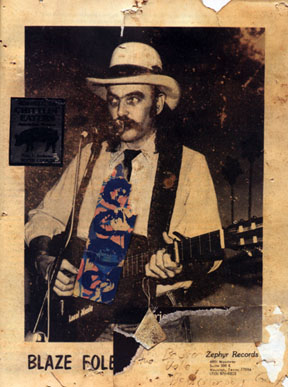
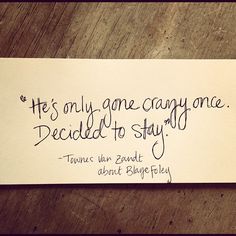
Blaze Foley.
This fuckin’ guy.

rake

“This has been a novel about some people who were punished entirely too much for what they did. They wanted to have a good time, but they were like children playing in the street; they could see one after another of them being killed–run over, maimed, destroyed–but they continued to play anyhow.

We really all were very happy for a while, sitting around not toiling but just bullshitting and playing, but it was for such a terrible brief time, and then the punishment was beyond belief: even when we could see it, we could not believe it.

It was, this sitting around with our buddies and bullshitting while making tape recordings, the bad decision of the decade, the sixties, both in and out of the establishment. And nature cracked down on us. We were forced to stop by things dreadful.

If there was any “sin,” it was that these people wanted to keep on having a good time forever, and were punished for that, but, as I say, I feel that, if so, the punishment was far too great.  I loved them all.  Let them all play again, in some other way, and let them be happy.

-Philip K. Dick, A Scanner Darkly

in the pines

Would’st thou shape a noble life?
Then cast no backward glances
towards the past, and though
somewhat be lost and gone, yet
do thou act as one newborn.”

-Goethe

a Leadbelly joint

Website Powered by WordPress.com.

Up ↑